Ocupa Silo stimulates artistic and cultural life in Vale Paraíba and Serra da Mantiqueira
14 July - 2025
With joy and great public participation, the festival united local and contemporary expressions in a living network of local artists
On July 5 and 6, Silo – Arte e Latitude Rural, located in Serrinha do Alambari, in Resende (RJ) hosted another Ocupa Silo, the Traditional and Contemporary Culture Festival of Vale do Paraíba and Serra da Mantiqueira, which brought together local, popular, and contemporary manifestations in a free and open-to-the-public gathering. Since it took place in July, this time the event took on the format of an Arraiá (traditional June festival) and was marked by much celebration of local art and culture in a welcoming environment built collectively for the well-being of all, through the integration of various artistic languages and the strengthening of the regional economy.
Silo’s initiatives propose an immersion in collective making and invite everyone not only to appreciate but also to collaborate with the space. Around 30 artists participated in the festival, which attracted an audience of almost 300 people over the weekend.
One of Silo’s great characteristics is to offer moments of encounter among art makers from a region by crossing the paths of these artists, opening everyone’s eyes to local cultural power. Ocupa Silo is no different. During the two days of action, artists found themselves in a place rich with possibilities for articulation to enhance the cultural scene of Vale do Paraíba and Serra da Mantiqueira.
“Bringing theater research to Ocupa Silo allowed me to share our artistic productions while also enjoying the creation of other artists and collectives. Silo’s headquarters is an extremely welcoming and stimulating space for this exchange. Realizing that while we are in the middle of the Mantiqueira mountains, we are also sharing artistic productions that are in no way inferior to major urban cultural centers, and this is a privilege for us, a collective stimulus for exchanges and encouragement,” comments Takna Formaggini, Master Professor of Theater at the Federal Institute of Rio de Janeiro, where she coordinates the Research-Extension Laboratory in Theater (Labex Teatro) at IFRJ campus Resende.
Saturday, July 5
The first day of Ocupa Silo was intense. The journey began with the screening of the documentary Farinha do Pinhão: Uma Herança da Mantiqueira (Pine Nut Flour: A Heritage of Mantiqueira), followed by a conversation circle with the guardians of pine nut flour production and Arasy Benitez, creator and executive producer of the film.
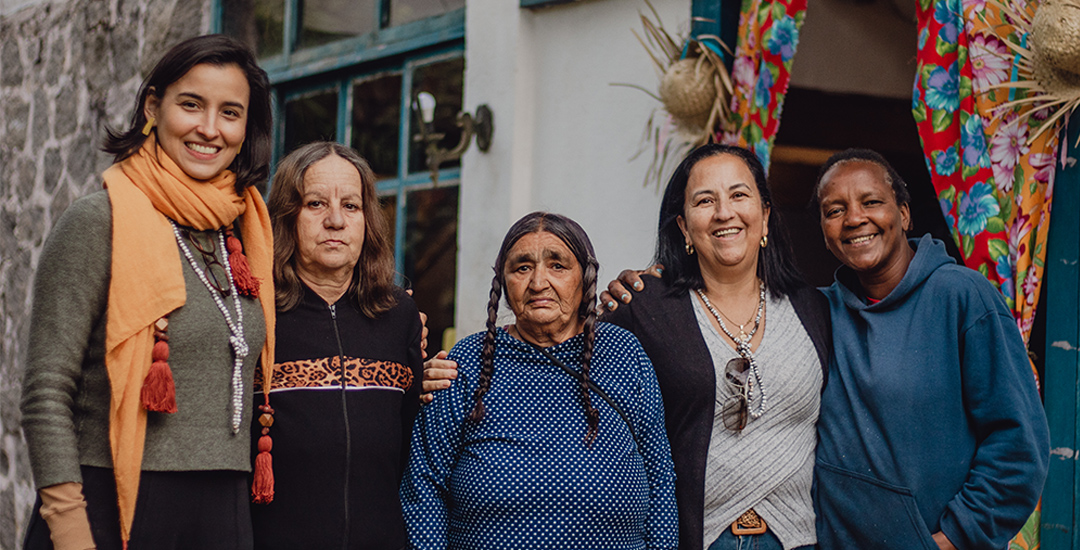 Guardians of the ancestral knowledge of pine nut flour production from Serra da Mantiqueira and Arasy Benitez, creator and executive producer of the documentary “Farinha do Pinhão: Uma Herança da Mantiqueira,” share experiences and technical knowledge with the Ocupa Silo audience. Photo: Kamay
Afterwards, there was the launch of the book A Cruz e a Espada: uma reflexão das políticas indigenistas e seus impactos no Vale do Paraíba - XV ao XVIII (The Cross and the Sword: a reflection on indigenous policies and their impacts in Vale do Paraíba - 15th to 18th century), by author Enio S. C. de Oliveira, with the participation of Angelo de Paula, author of Escravidão indígenas nos sertões da Paraíba Nova (Indigenous slavery in the backlands of Paraíba Nova). The program continued with creative workshops led by Cecília Bianco, Storytelling with Gabriel Sant’ana, Sound art from Zumbido’s creation, and the theatrical play Toda Nudez – Excertos de uma Experiência Obsessiva (All Nudity - Excerpts from an Obsessive Experience) by Coletivo Labex Teatro. The night ended to the sound of Fogueira Doce and accordion player Dedé, who brought joy and rhythm through forró.
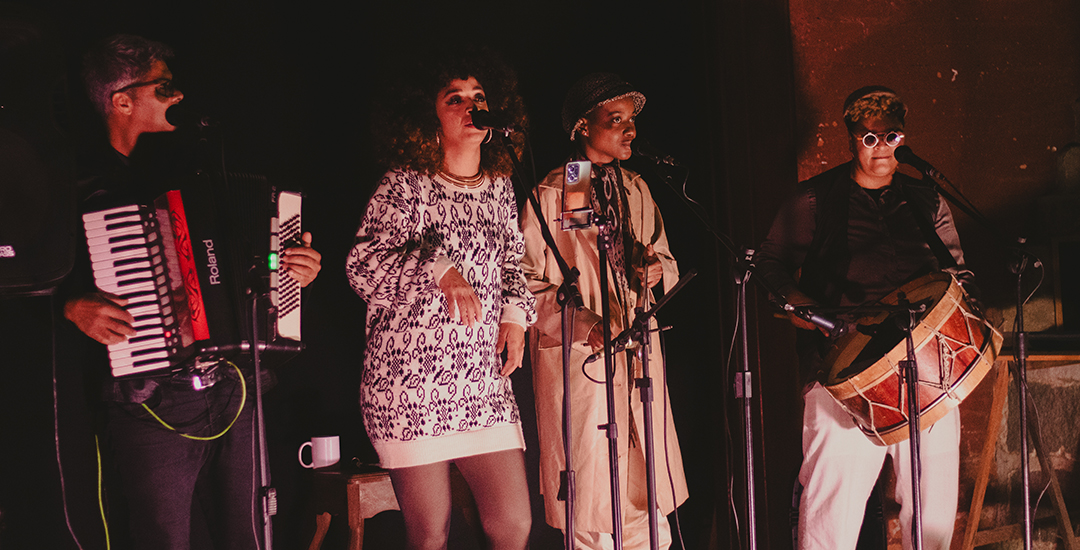 Fogueira Doce and accordion player Dedé captivate the Ocupa Silo audience through the engaging sound of Forró. Photo: Kamay
Cecília Bianco brought colors, creativity, and playfulness to the lawn at Silo’s headquarters, engaging children, youth, and adults in an experience of collective discovery. Her proposal invited each person to explore the possibilities of creation - whether or not they were artists - from the encounter with others and with Nature, in addition to sharpening the perception that there is creativity in everyday processes.
The creative workshops are also activities that work on trust and encouragement. Walking on Silo’s lawn with closed eyes and with the help of other participants, each member was invited to discover the natural environment and connect with the surroundings through a sensitized and grateful perspective.
The activities ran from 2 pm to 5 pm and were experienced with great commitment from beginning to end, both by children and by adults who allowed themselves to play. “The generational link is important in the sense of us reversing the roles a bit. […] As adults, we allow ourselves to see the world from the child’s perspective. We allow ourselves to be enchanted by a new discovery, we allow ourselves to be moved by the small things and beauties that surround us,” explains educator and artist Cecília Bianco.
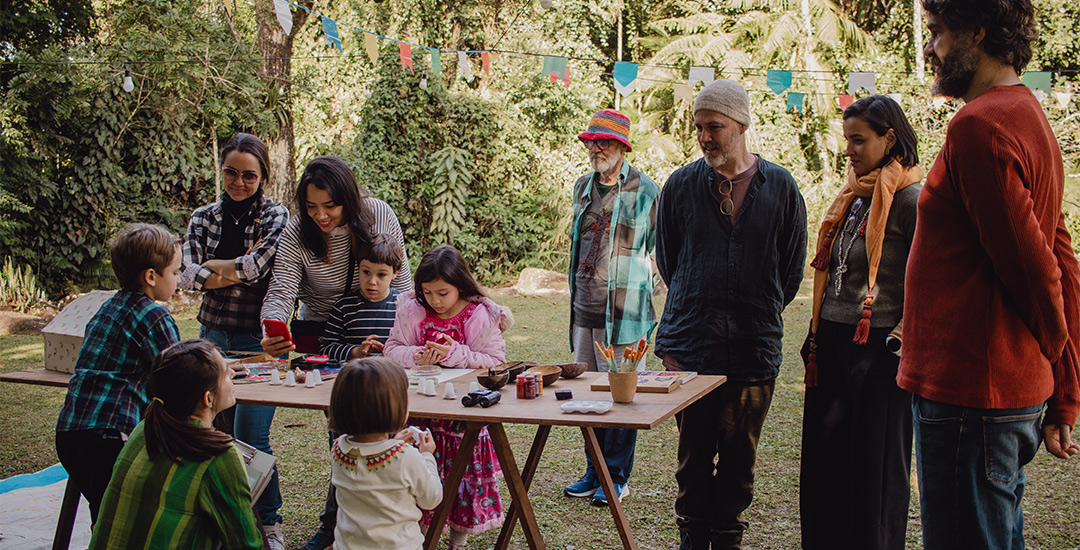 Cecília Bianco attracts children, youth, and adults on the lawn at Silo’s headquarters, generating an intergenerational collective interested in creation and art. Photo: Kamay
Gabriel Sant’Anna, Storyteller, presented a performance with a proposal similar to Cecília Bianco’s: bringing together different generations around imagination. Through singing, narration, and interaction, Gabriel led the audience to close and open their eyes and feel through evoked images. “Open your eyes, open your nose, and especially your heart,” the artist said during the presentation.
The show was inspired by three stories taken from the work Solo de Histórias – contos daqui, ali e de toda parte (Solo of Stories - tales from here, there, and everywhere), written by him in partnership with Martha Paiva from the Rio group Cia do Solo.
 Gabriel Sant’Ann, Storyteller, in a solo presentation at Silo - Arte e Latitude Rural headquarters. Photo: Kamay
In addition to all the presentations, the Ocupa Silo kitchen offered typical arraiá foods (sweet canjica, curau, and broths) and quentão (hot spiced drink), which warmed the hearts of those who participated.
“I loved the place, the broths, and the wonderful quentão! Pure Art!”, writes Cida Lisboa on Silo - Arte e Latitude Rural’s Instagram.
Sunday, July 6
The second day’s (6th) program maintained the same brilliance. As a good Sunday calls for, the gathering began with the traditional Prize Show, a game much appreciated by Serrinha residents, followed by a family meal. The Ocupa Silo kitchen served a typical Afro-Brazilian dish: feijoada, in both traditional and vegan versions. From there, the day continued as promised, with presentations by Otton Maciel and Hilton Fonseca; by Gabriel Sampaio and the moving jongo circle from Pinheiral.
After Otton Maciel recited rural poetry, Mr. Hilton Fonseca, accompanied by two other musicians he brought, celebrated the tradition of rural music. The moment was so special and inviting that other artists spontaneously joined in, making a unique presentation full of exchanges and improvisations flourish.
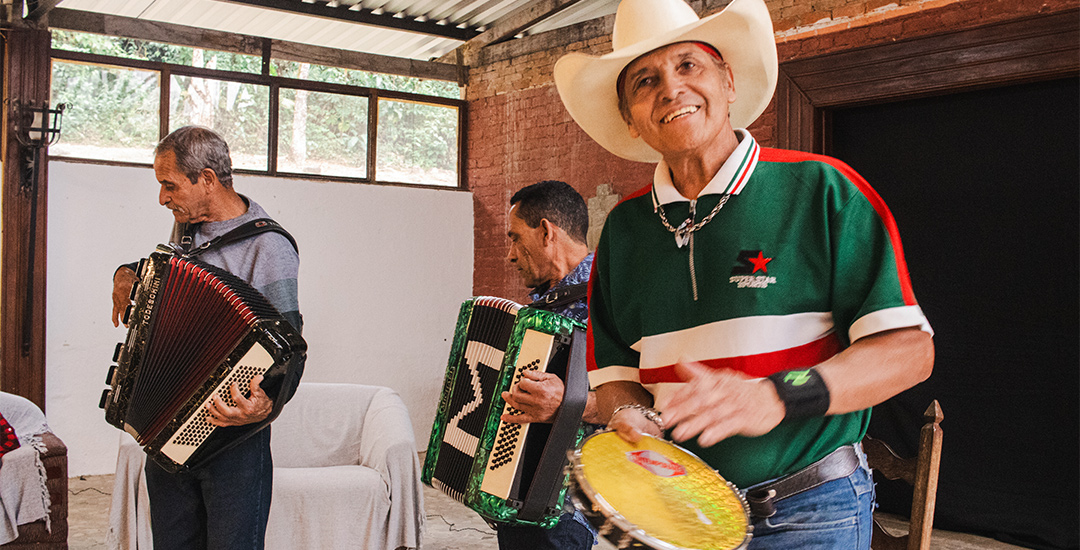 Mr. Hilton and guests entertain the Ocupa Silo audience, showing the musicality and intelligence of rural culture. Photo: Kamay
Ocupa Silo closed the event with Jongo de Pinheiral, an Afro-Brazilian cultural manifestation inherited from Black ancestors enslaved on coffee plantations during the colonial period. The audience was first invited to hear a part of Brazil’s resistance history that is rarely told. Then, they watched a typical opening, dedicated to blessing the terreiro (ceremonial space). Afterwards, everyone was called to enter the circle and enjoy the ancestral strength of jongo.
“Jongo is memory. They organized themselves for escapes, to sing about missing Africa, to court… everything happened in Jongo circles, in the yards in front of the slave quarters beside a bonfire. And we do this to this day, seeking public policies for our people, seeking better working conditions, seeking opportunities for our youth at universities… We do all this through Jongo,” explains Fatinha, representative of Jongo de Pinheiral.
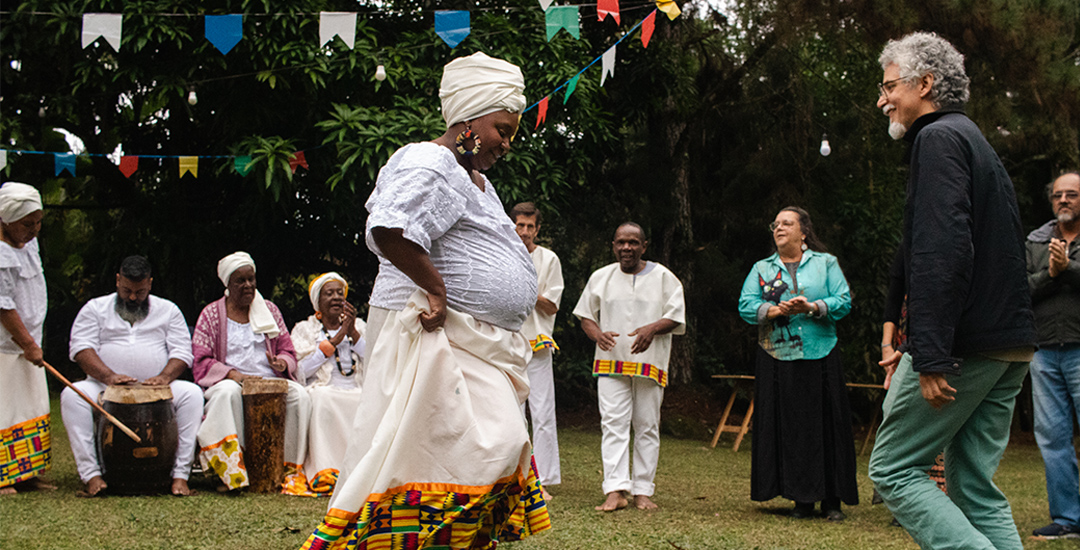 Ocupa Silo closes the program with the presentation of Jongo de Pinheiral, which provided a moment of ancestral celebration with much fun and audience integration. Photo: Kamay
Ocupa Silo is a constant invitation for the local population to occupy the space of Silo - Arte e Latitude Rural in order to strengthen the bond with the territory, both in its symbolic and geographic sense. “This occupation space has welcomed quality artistic manifestations and functions as a stimulus for the continuity of these projects and also the strengthening and recognition of local rural cultural production,” concludes Professor Takna Formaggini.



 CC BY-SA 4.0