SEMINAR CULTURE AND ART HIGHLIGHTS INNOVATIVE AND TERRITORIALIZED MANAGEMENT
18 September - 2025
Held at Casa Firjan, the event presented creative cultural management practices taking place in the state of Rio de Janeiro, adapted to the particularities of each territory.
Bringing together researchers, professors, cultural managers, artists, and communication professionals; the Culture and Art seminar occupied Casa Firjan, in Rio de Janeiro, on September 12. The program brought reflections on territory, diversity, and cultural management in Rio de Janeiro, in addition to provoking debates about public policies and the directions of culture in the digital age. The seminar inaugurated an annual agenda that aims to promote innovations, studies, and research about the country’s culture and art.
The meeting was also marked by the launch of the book “Cultural Management, Territory and Diversity”, the result of a partnership between Firjan Sesi, Observatório de Favelas, Unirio, and Lactus. The publication presents experiences of eight institutions in the State of Rio de Janeiro that are rooted in their territories and that develop their own methodologies and technologies to meet local demands. The institutions studied were: Silo - Arte e Latitude Rural, Balaio Cultural, EncontrArte, Casa de Artesanato - ACIGUA, Coletivo Ponte Cultural, Franproduz!, Quilombo São José da Serra, and Rio Parada Funk.
Vinicius Cardoso, director of Education and Culture at Firjan SENAI SESI, and Antenor Oliveira, manager of Culture and Art at Firjan SESI, opened the event at 9 am. Next, there was an institutional presentation of SESI - National Department, conducted by Claudia Ramalho, superintendent of Culture, and Paula Bosso, national manager of Culture Policy.
The opening speeches highlighted the satisfaction with holding the meeting, the result of a long joint effort. They also reinforced the institutions’ commitment to promoting debates and articulating culture and art professionals in contemporary times, emphasizing the importance of integrating culture with territories and their realities. Finally, they encouraged a broader view of the economy, recognizing culture as an economic vector that is strengthened by the collaborative work of cultural managers.
 Entrance panel of the Culture and Art seminar, held at Casa Firjan - Rio de Janeiro
The first panel, titled “The role of research and studies in formulating paths for Cultural Management”, brought together Joana Afonso Siqueira, Consultant for Studies and Research at Firjan and advisor to the Business Council for Creative Industry; Lia Baron, Professor of Arts and Culture at UFF; and Manoel Silvestre Friques, Professor of Production Engineering at Unirio, Graduate Studies in Performing Arts at UFRJ, and Graduate Studies in Social Memory at Unirio. The panelists highlighted the current moment as a scenario of cultural revival, continuing the work started in the 2000s, when artistic practice began to value local and identity-based manifestations and demands. This movement, according to them, has enabled the emergence of managers who develop methods and apply specific technologies for each territory.
During the panel, the use of data as a tool for strengthening the creative industry was also highlighted, allowing for the analysis of new cultural and artistic consumption habits and the optimization of strategies. The debate also included the presentation of the books Cultural Pact – produced by Firjan SESI, SESI, Arte e Fato and UFF, published in 2023 - and Cultural Management, Territory and Diversity, launched this year.
In the final part of the first panel, Manoel Silvestre Friques highlighted the work of universities and institutions, such as the Observatório de Favelas, in producing data and mappings that support managers and cultural agents in organizing their own narratives and productions. He also invited reflection that creativity is not limited to artistic products: it is also expressed in management practices, which can inspire and influence cultural policies; and proposed expanding the view to think about cultural engineering.
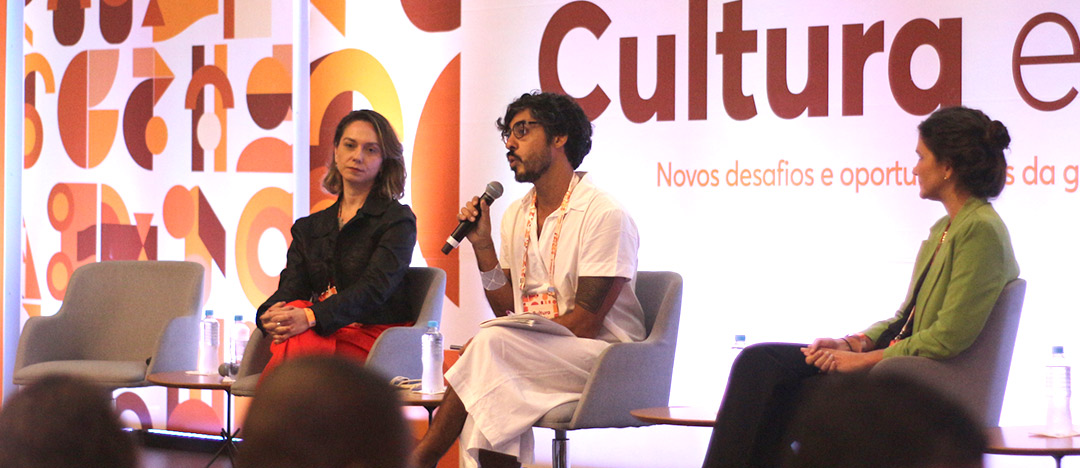 Panel “The role of research and studies in formulating paths for Cultural Management” composed of Joana Afonso Siqueira, Lia Baron and Manoel Silvestre Friques
The panel “The future of culture and the audiovisual industry in the digital age”, with Antenor Oliveira, Specialist in Cultural Management; Ivana Bentes, vice-rector of Extension at UFRJ and president of the Forum of Extension Vice-Rectors of Brazilian Public Universities; Pedro Tourinho, Communications specialist and Communications entrepreneur, and Julia Zardo, PhD in Public Policy, Strategy and Development from the Institute of Economics at UFRJ; presented an overview of the new cultural consumer, highlighting how social transformations redefine consumption habits and profiles. The panelists showed the importance of understanding how people consume culture on social networks. A curious fact shared by the participants showed that Instagram is used as an entertainment channel and has consolidated itself as one of the largest sources of access to cultural activities.
The conversation also addressed the functioning of algorithms, the formation of cultural bubbles and the challenges to break them, in addition to highlighting regulation as an essential measure in the face of the advancement of Artificial Intelligence and the need to democratize access to culture.
After lunch, at 2 pm, the Seminar resumed activities with the panel “Pact for Culture”, which brought together Geórgia Nicolau, Co-founder and executive director of Instituto Procomum; Fernando Mencarelli, president of the Cultural Management Forum of Public Higher Education Institutions and professor at UFMG; Luciana Adão, specialist in cultural innovation; and Luisa Hardman, General Coordinator of Support at the National Arts Foundation (Funarte); moderated by Lia Baron. The meeting emphasized the importance of different civil society agents in the resumption of public policies and research on culture, in addition to the work of institutions that produce data, mapping, and debates focused on the future of the country’s cultural policies.
After the “Pact for Culture” panel, the event took another break for rest, snacks, and preparation for the final part, consisting of the panel “Cultural Management, Territory and Diversity in Rio de Janeiro”, followed by a jongo presentation by Quilombo São José da Serra, from Valença (RJ).
The discussions emphasized the need for a renewed cultural engineering driven by territorial and identity dynamics, aimed at democratizing access and promoting social justice. Next, the program brought examples of civil society institutions that demonstrate, in practice, how this path is possible and transformative.
Panel: Cultural Management, Territory and Diversity in Rio de Janeiro
The book “Cultural Management, Territory and Diversity” gathers experiences of eight institutions deeply connected to their territories, which create their own methodologies and technologies to meet local demands. The book was launched during the Seminar, in a panel moderated by Rebeca Brandão, with the participation of Cinthia Mendonça (Silo – Arte e Latitude Rural), Claudina Olivêira (EncontrArte), Almir Gonçalves (Quilombo São José da Serra), and Mateus Aragão (Rio Parada Funk). The conversation started at 4:15 pm and marked the conclusion of the panels.
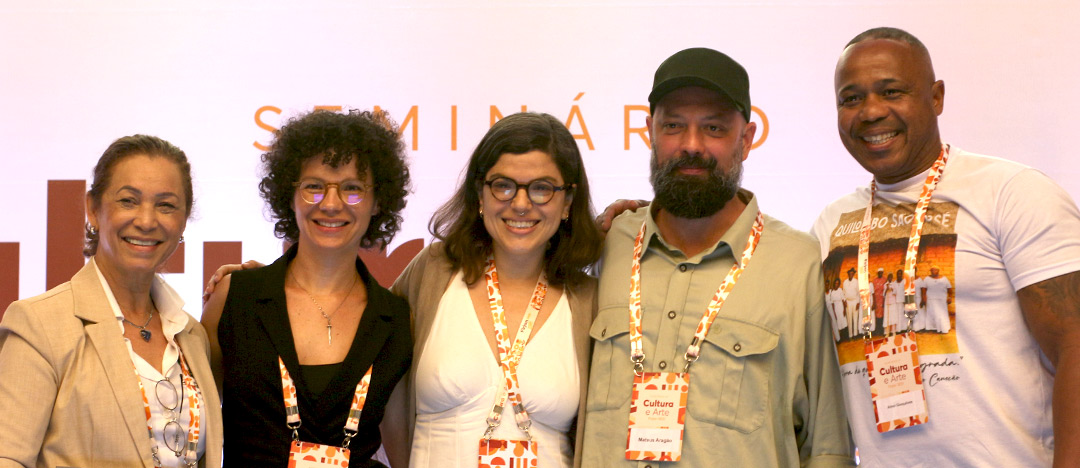 Cinthia Mendonça, Claudina Olivêira, Almir Gonçalves, Mateus Aragão and Rebeca Brandão after the panel “Cultural management, territory and diversity in Rio de Janeiro”
According to Rebeca Brandão, the book can be understood as a manual for thinking about cultural policies based on methods and technologies that are developed by people who manage civil society organizations in territorialized communities in the State of Rio de Janeiro.
Before beginning the panelists’ speeches, Pedro, from Aldeia de Paraty Mirim, emphasized the importance of cultural strengthening work within the community, followed by a moment of indigenous singing that engaged and moved the audience.
After the participation of the indigenous representatives, Claudina Olivêira, from EncontrArte, in Nova Iguaçu (Baixada Fluminense), presented the institution’s projects and the results of the audiovisual school created by the group. Moved, she could not hold back tears as she recounted the organization’s trajectory and the lives transformed by its work. Claudina Olivêira commented that the greater the access to and consumption of art, the lower the incidence of hate crimes.
Next, it was Almir Gonçalves’ turn, from Quilombo São José da Serra, in Valença (RJ). The panelist presented the history of his community from the memories passed down by ancestors, highlighting that the quilombo is the oldest in the state and a reference in the tradition of jongo circles. Almir explained that the drum functioned as a means of communication when the voices of Black people were silenced, allowing enslaved people to connect through the drumbeat. Today, jongo continues as an instrument of resistance, in addition to being a way to demand public policies for the community.
Quilombo São José da Serra holds one of the largest traditional quilombo festivals in the State of Rio de Janeiro; and since the nineties, has opened its doors for community visits.
Cinthia Mendonça presented the programs developed by Silo - Arte e Latitude Rural, highlighting the importance of diversity and actions that operate in the local-global logic. The director also took the opportunity to emphasize the unifying character of the institution, which creates bridges between peasantry and the city, especially approaching peripheral communities; and the artistic aspect that runs through the origin, management, and execution of the programs - both in methodologies and in the way technologies are used.
In addition, the audience was also invited to reflect on how the ways of life that ruralities offer can inspire new ways of thinking about contemporary culture and the future.
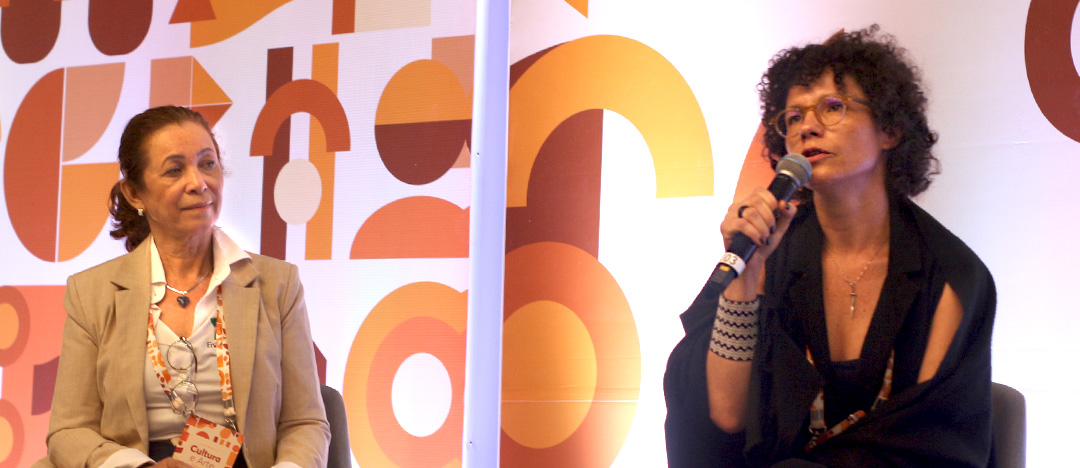 Cinthia Mendonça, at the Cultural Management, Territory and Diversity in Rio de Janeiro panel, presents the institution Silo - Arte e Latitude Rural and its operational methodologies. Beside her is Claudina Olivêira, from EncontrArte.
Finally, the Rio Parada Funk project, conceived and led by Mateus Aragão, closed the panel. Active for 15 years, the initiative offers a safe space for the creation and consumption of funk. During the conversation, Mateus reported episodes of police oppression faced by peripheral youth at funk houses, highlighting that Rio Parada Funk remains an important instrument in the fight against prejudice toward peripheral artistic manifestations.
The Seminar provided a rich overview of cultural diversity and presented possibilities for creative cultural management, bringing together experiences of organizations working in the periphery, the countryside, and traditional communities; to think about the future of culture in the country. The event ended with a jongo presentation by the São José da Serra community, celebrating the resistance and richness of Afro-Brazilian traditions.
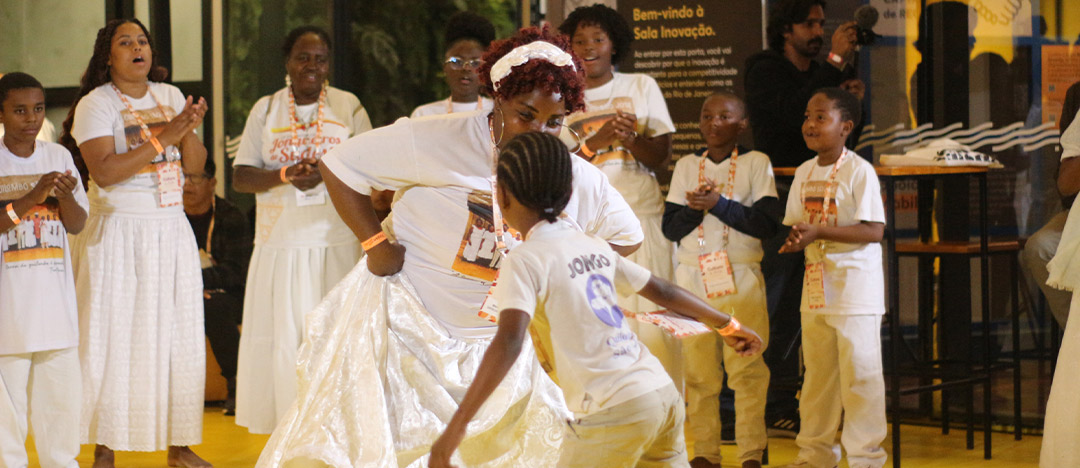 Jongo circle of Quilombo São José da Serra, from Valença (RJ), closes the Culture and Art seminar.



 CC BY-SA 4.0